woensdag 19 oktober 2016

Marketing planning and forecasting sales potential

For the first question we had to estimate the market potential and sales potential for the brand that we chose. I used the build-up approach to estimate the market potential and sales potential for the brand Amstel. The most popular costumer of Amstel are cafés. In 2015 there were 12,835 cafés/bars in the Netherlands (Euromonitor, 2016). The market share of Amstel in 2015 was 9.2%. So if around 9.2% of the bars sell Amstel, then 1180 bars sell Amstel. The last years the brand share of Amstel decreased. It started with 10.6% in 2012. Then it decreased with 0.2% so in 2013 it was 10.4%. Then from 2013 to 2014 it decreased with 0.6%, and from 2014 to 2015 again a decrease of 0.6%. The average of these numbers is 0.46%, so the sales potential in 2015 will probably be 8.7%. This means that 1116 bars will sell Amstel in 2016. If each bar sells about 60000 glasses of Amstel a year, then the market potential will be 66960000 glasses of Amstel a year. (Euromonitor, 2016)

Secondly I had to give valid reason why Heineken should write a marketing plan for the Dutch market, and also a reason why they shouldn't. The first reason why Heineken should write a marketing plan for Amstel in the Dutch market is because the population is growing. This means they have to find ways to sell their products to the new potential buyers. Another reason would be that they can grow even more as a company. There are several different beer brands in the Netherlands and they could find a way to get even more costumers. The last reason is because they want to keep the costumers they have now. They don’t want their costumers to go to another brand, for example Grolsch. They want to find ways to keep their costumers loyal to them. (Dibb, Simkin, Pride, & Ferrell, 2016)

But I also thought of a reason why they shouldn't make a marketing plan for the Dutch market. A reason why they should not write a marketing plan for the Dutch market is because the Netherlands is a very small country. They could better focus on bigger countries with bigger markets, like for example the US.

At last I had to choose sales forecast technique which I would use for my product. I would use the expert forecasting survey. An advantage for this technique is that you ask experts to prepare your sales forecast. This is their expertise, so they will be very useful for the forecast. Another advantage is that it is not very expensive to ask questions concerning sales forecast to the experts. A disadvantage may be that the experts do not work for your company, so they may be less motivated than company personnel. Another disadvantage is that they can never be certain about what is going to happen to the company in the future, so you may be thinking that they are experts, but they can’t predict the future. (Dibb, Simkin, Pride, & Ferrell, 2016)


Bibliography

Dibb, S., Simkin, L., Pride, W. M., & Ferrell, O. (2016). Marketing Concepts and Strategies (7th ed.). China: RR Donnelley.
Euromonitor. (2016, June 7). Beer in the Netherlands. Retrieved October 19, 2016, from Euromonitor: http://www.portal.euromonitor.com.saxion.idm.oclc.org/portal/analysis/tab

Euromonitor. (2016, May 9). Cafés/Bars in the Netherlands. Retrieved October 19, 2016, from Euromonitor: http://www.portal.euromonitor.com.saxion.idm.oclc.org/portal/analysis/tab

woensdag 12 oktober 2016

Marketing in international markets and globalization

The brand Amstel is a international brand. The manufacturer of the brand Amstel is Heineken and the level of international involvement of Heineken is Global marketing. This means that they are totally global orientated. Global marketing occurs when marketing strategies are developed for the entire world to enable competition globally. Heineken is one of the biggest beer manufacturers in the world, and is sold in almost every country. The product Amstel is available in over 80 countries, with markets in Greece, The Netherlands, South Africa, Spain, Hungary, the UK, Switzerland Portugal and many more. (Kochan, 2016)

Here are some market shares of Amstel in Greece and Spain:


Beer shares in Greece:
In this table you can see that Amstel has the biggest brand share in Greece. But you can also see that the brand share of Amstel has decreased by 11% from 2011 to 2014. 


                                                                                                                                                                                                                                                    (Euromonitor, 2016)                                                                                                       


Beer shares in Spain:
In this table you can see that Amstel has around 7% of the brand shares in Spain. The brand with the biggest brand share, which is Cruzcampo, is from the same manufacturer as Amstel, Heineken NV.
                                                                                     (Euromonitor, 2016)
          
Heineken uses different market entry strategies to penetrate foreign market. To enter the market of the US, Heineken used the market strategy exporting because it had a low risk and cost. To enter the market of Asia, Heineken used the market strategy joint venture. They had a partnership with Frasere & Neave and became Malayan Breweries. (The Finance Director, 2012)

There can be found evidence of impact of the recent international turmoil on the company of my product, Heineken. The Brexit has impact on the company Heineken, because of the Brexit large beer brewers like Heineken will have to shift its business models from imported to licensed beer depending on the positioning and consumer perception of the brand (Mortimer, 2016). Also the Ebola virus in Africa had an impact on Heineken. The unit of Heineken in Sierra Leone had to fire staff and stop the expansion plans worth about 12 million dollars. A spokes said that sales had dropped 70 per cent in October, which is risky for the supply chain. (OECD iLibrary, 2015)

At last I found some legal forces that have an impact on the marketing position of your product. The following three have an impact on the marketing position:

The beer industry players have to follow the advertising norms. These show the content and hours when beer advertisements may be broadcasted to minimize instances of underage drinking. America also has a control system that separates players into manufacturers, wholesalers and retailers, and they are not allowed to sell beer directly to the public. The tax code divides brewers according to their size, with small brewers that produce up to two million barrels per year and the large brewers any amount above it, although taxes are paid on every barrel that is produced. (Lowrie, 2016)
                                                                                               

Bibliography

Euromonitor. (2016). Beer in Greece. Retrieved October 12, 2016, from Euromonitor: http://www.portal.euromonitor.com.saxion.idm.oclc.org/portal/analysis/tab
Euromonitor. (2016). Beer in Spain. Retrieved October 12, 2016, from Euromonitor: http://www.portal.euromonitor.com.saxion.idm.oclc.org/portal/analysis/tab
Kochan, N. (2016). The World's Greatest Brands. Retrieved October 12, 2016, from Google Books: https://books.google.nl/books?id=LDqvCwAAQBAJ&pg=PT8&lpg=PT8&dq=international+brand+amstel&source=bl&ots=dc4fG1fdDM&sig=3RIDrHHhq4M5STDAY9O2T0g6tqw&hl=nl&sa=X&ved=0ahUKEwjg8enfx9XPAhXCDcAKHUJxC5QQ6AEIVTAJ#v=onepage&q=international%20brand%20amstel&f=false
Lowrie, L. (2016). Beer Industry Legal & Political Factors. Retrieved October 12, 2016, from Small Business: http://smallbusiness.chron.com/beer-industry-legal-political-factors-75952.html
Mortimer, N. (2016, July 25). Why Brexit could boost craft beer but hurt big beer businesses. Retrieved October 12, 2016, from The Drum: http://www.thedrum.com/news/2016/07/25/why-brexit-could-boost-craft-beer-hurt-big-beer-businesses
OECD iLibrary. (2015). The Ebola Crisis in West Africa: Implications for Trade and Regional Integration. Retrieved October 12, 2016, from OECD iLibrary: http://www.oecd-ilibrary.org/docserver/download/5js4t73pl5mt.pdf?expires=1476307755&id=id&accname=guest&checksum=DA483E97D2AC68AA254F288C5A1F2AD0
The Finance Director. (2012, May 18). Heineken: An acquired taste. Retrieved October 12, 2016, from The Finance Director: http://www.the-financedirector.com/features/featureheineken-rene-hooft-graafland-high-growth-markets-acquisitions-expansion


maandag 10 oktober 2016

Environmental Analysis

First we had to look at the press clippings and annual report of our product and indicate the environmental factors that have a major impact on the marketing policies. Because the head office of the brand Amstel is Heineken, I looked at the website of Heineken and their annual report. On the Heineken N.V. 2016 half year results, Jean-François van Boxmeer, CEO and Chairman of the Executive Board comments that the performance on the markets of Africa, the Middle East and Eastern Europe remained challenging. On the other hand, the performance on the key developing markets like Vietnam and Mexico was really strong. So the competition has a major impact on the marketing policies. “We are convinced that our well-balanced global footprint, sustained investment in brands and innovation, and focus on the premium segment continue to give us a unique competitive advantage to win in our markets.’’ (Heineken, 2016)
Also social and cultural forces have a major impact on the marketing policies. Because through social and cultural forces thought patterns and lifestyles will be influenced, which can be a disadvantage for a company as Heineken. If for example your lifestyle includes to drink another beer brand, then it is a disadvantage for Heineken, so it impact the marketing policies of Heineken.

Then I found two tables on CBS Statline that give relevant data about the external environment for my product. I found the following tables:

In the table Population; sex, age and nationality there is information about which nationalities live in the Netherlands. This can be important because in some cultures it is not allowed or no habit to drink alcohol, so these nationalities have impact on the consumption of Amstel. (CBS Statline, 2015)
In the table Consumer prices; price index there is information of the CPI over the years for different beers. This is important because the CPI shows the change of price over time, and the change of price is very important for the competitive position of the company. (CBS Statline, 2016)

At last I had to look at the influence of the social, cultural and religious differences in the Netherlands on the brand Amstel. In the Netherlands there are quite a lot of social, cultural and religious differences. You have several religions in the Netherlands, like for example Christianity, Islam, Hinduism, Buddhism etc. These all have influence on the consumption of the product Amstel, because in most religions it is not allowed to drink alcohol, so they don’t even consume any Amstel. There are also a lot of different cultures in the Netherlands, which also influence the consumption of Amstel, because in some cultures it is not allowed to drink. But in the Dutch culture it is very normal to drink a beer with friends, family, when going out or sitting at a restaurant, so this has a good influence on the consumption of Amstel. The social differences in the Netherlands also influence the consumption, because older people may drink less alcohol than younger people. (CountryReports, 2016)


Bibliography


CBS Statline. (2015, August 12). Population; sex, age and nationality, 1 January. Retrieved October 10, 2016, from CBS Statline: http://statline.cbs.nl/Statweb/publication/?DM=SLEN&PA=03743ENG&D1=1&D2=119-125&D3=a&D4=17-19&LA=EN&VW=T
CBS Statline. (2016, October 6). Consumer prices; price index 2015=100. Retrieved October 10, 2016, from CBS Statline: http://statline.cbs.nl/Statweb/publication/?DM=SLEN&PA=83131eng&D1=0-1,4-5&D2=78-81&D3=(l-39)-l&LA=EN&VW=T
CountryReports. (2016). Netherlands Facts and Culture. Retrieved October 10, 2016, from CountryReports: http://www.countryreports.org.saxion.idm.oclc.org/country/Netherlands/facts.htm
Heineken. (2016, August 1). Heineken N.V. reports 2016 half year results. Retrieved October 10, 2016, from The Heineken Company: http://www.theheinekencompany.com/media/media-releases/press-releases/2016/08/2032068


woensdag 28 september 2016

Business Marketing

Amstel is being sold in several business markets. A couple of examples of these business markets are:
·         
  •       De Vrienden van Amstel Live: This is a big event in the Netherlands and is being organized by Amstel. It takes place in Ahoy Rotterdam.
  • ·         Amstel Gold Race: This is a cycle racing weekend in Valkenburg, the Netherlands. The event is organized by Amstel.
  • ·         Pubs and restaurants: Pubs and restaurants also buy Amstel from a wholesale, and not from supermarkets. Therefore it is also a business market.

For these events, the logo of Amstel is being adapted to the business markets. For both events Amstel has created different logo’s. In Pubs and restaurants there are no adaptations.

Afbeeldingsresultaat voor amstel gold race logoThis logo is being created for De Vrienden van Amstel Live. It is different from the original Amstel logo and it’s only being used for this event.
(Wander, 2014)

Afbeeldingsresultaat voor vrienden van amstel live logoThis is the logo Amstel created for the Amstel Gold Race. It is also different from the original Amstel logo and is being used in the Amstel Gold Race.
(Dijk, 2013)

Business purchases
The business purchases can be divided in these three types: new task purchase, modified rebuy purchase or straight rebuy purchase. The straight rebuy purchase would be most likely applicable on Amstel, because ‘A straight re-buy purchase occurs when a buyer repurchases the same products routinely under approximately the same terms of sale.’ (Dibb, Simkin, Pride, & Ferrell, 2012) Amstel is being bought routinely under the same terms of sale by the events and the pubs and restaurants, so it is a straight rebuy purchase.

Buying process of Amstel in pubs
The Amstel that is produced in the brewery will be sold to wholesale. Then the pub owner buys the Amstel beer from the wholesale. The people involved in the purchase (the buying center) are the pub owner and the consumers of the pub. The pub owner buys the Amstel beer from the wholesale, and the consumers buy the Amstel in the pub.

Derived Demand
Derived demand means that the demand for consumer products influences the demand for business products. The demand depends on the consumers of the pub, because it depends on what the consumers drink. If they drink for example a lot of Grolsch and almost no Amstel, then this will affect the amount of Amstel the pub owner will buy.


Bibliography

Dibb, S., Simkin, L., Pride, W. M., & Ferrell, O. (2012). Types of business purchase . In S. Dibb, L. Simkin, W. M. Pride, & O. Ferrell, Marketing Concepts and Strategies (p. 188). China: RR Donnelley.
Dijk, T. v. (2013, April 12). Amstel Gold Race 2013 – De beklimmingen. Retrieved September 28, 2016, from Cycling Story: http://www.cyclingstory.nl/2013/04/12/amstel-gold-race-2013-de-beklimmingen/
Wander, W. (2014, January 15). Muziek Nieuws. Retrieved September 28, 2016, from Maxazine: http://www.maxazine.nl/2014/01/15/vrienden-van-amstel-live-bevestigd-voor-2015/


woensdag 21 september 2016

Social environment of consumers

The social environment of the consumer has a lot of influence on the use of products. The different factors of social environment are family, friends, school, work and basically everything in your surroundings. For example if you are born in the Achterhoek (an area in the eastern part of the Netherlands) then you are more likely to drink the beer brand Grolsch then if you are born somewhere else in the Netherlands, because you are influenced by the people in the area who brew and drink it. This is the way it goes with every brand, if your close surroundings drink, eat or use a product, then you are likely to do the same. The way people are influenced by Amstel is the same, you are more eager to drink Amstel when your friends and family drink it as well. On the other hand, when a culture or a belief forbids the use of alcohol, you won’t be drinking any beer. This is also because of your social environment, because you are not allowed to drink alcohol, you won’t do it. 

Also the circumstances have a major influence on the consuming of beer. At a party, most of the people like to drink beer, which is kind of a social pressure, because it encourages other people to drink beer as well. Also on a terrace in the sun it is tempting to drink a beer, or after playing a soccer match, it is tempting to drink some beer with your friends.


Afbeeldingsresultaat voor family life cycle
These are the stages of the family life cycle. As you can see there are six stages, and in every stage there is a different amount of consuming beer (Amstel).

Single Adult:
The single adult will probably be spending a lot of time with their friends. They will probably have more parties than while having children. I think that the consuming of beer (Amstel) will be quite a lot, because they have no obligations concerning a wife/husband or children. As they are adults and therefore allowed to drink alcohol, they will probably consume a lot of beer (Amstel).

New Couple:
As a new couple, they will probably consume less beer than when they were single, because they have more obligations. Still, they will consume quite some beer (Amstel), as they are still young and will go to parties together.

Couple with children:
A couple with children will reduce their drinking behavior even more, because they want to take care for their children and of course be a good example for them. They will still have some beer (Amstel), but not as much as when they had no children.

Couple with teenagers:
The couple still wants to be a good example for their children, by not drinking a lot of beer (Amstel). Their drinking behavior will therefore probably be the same as when they had little children.

Launching children:
The children left the house, which means the couple does not have to adjust their drinking behavior to their children anymore. They will enjoy the rest of their life and have a beer (Amstel) whenever they want.

Family in later life:
Their drinking behavior will reduce again, because they can’t drink as many beer (Amstel) as they used to do. They might also have grandchildren for which they want to be an example.


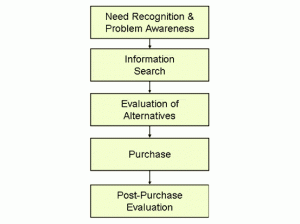
Afbeeldingsresultaat voor standard behavioral model
This is the standard behavioral model. It shows the five stages of the consumer when they want to buy a product. I will explain these stages with the product Amstel.

Need recognition & problem awareness:
This is the first step. The consumer realizes that he/she has a need for beer.

Information Search:
The consumer will look for solutions for this need. He will look at different brands, the taste, the prices etc. He will look at the internal information (consumer already knows this information), like for example he liked the taste of Amstel, so he will buy it again. Also the external information (information that is obtained by the consumer’s environment) plays a role, for example the consumer’s friends recommend Amstel, so he will try it.

Evaluation of alternatives:
The consumer will look at the different alternatives. He’s considering which beer brand to choose. For example if other beer brands are cheaper, perhaps it is tempting to buy one of those. Eventually he will make a decision, which leads to the next stage, purchase.

Purchase:
The consumer is buying the brand he eventually decided, Amstel.

Post purchase evaluation:
The consumer looks back at the decision he made. He considers if Amstel was the right decision, and if he will buy it again next time.


With this attitude scale you can show your thoughts about the brand Amstel. 

Amstel Beer
Very Bad
Bad
Neutral
Good
Very Good
The design of the bottle


Taste


Commercials and Advertisements


Price


Originality


Bibliography

Perreau, F. (n.d.). The 5 stages of Consumer Buying Decision Process. Retrieved September 21, 2016, from The Consumer Factor: http://theconsumerfactor.com/en/5-stages-consumer-buying-decision-process/
Pinterest. (2016). Family Life Cycle. Retrieved September 21, 2016, from Pinterest: https://nl.pinterest.com/pin/204913851769353835/

Riley, J. (2016). Reference Library. Opgeroepen op September 21, 2016, van Tutor2u: http://www.tutor2u.net/business/reference/marketing-buyer-behaviour-the-decision-making-process

woensdag 14 september 2016

Amstel Marketing Environment 1.2


Every company has a mission statement, but because Heineken took over Amstel they have the same mission statement. The mission statement from Heineken there for from Amstel is the following: They want to delight their consumers, day in and day out with their beers. They do it with a perfect cider, and the experiences of many beer brands.


Ofcourse there are a lot of competitors in the beer market, and here are some listed and they are divided into not well known brands and well known brands.
Generic competition:

  • Rolling rock
  • Schaefer
  • Old milquakee
  • Bud light


Product form competition:

  • Corona
  • Grolsch radler
  • Liefmans
  • Wiekse
  • Hoegaarden


Brand competition:

  • Grolsch
  • Hertog Jan
  • Gulpener
  • Bavaria
The competitive position of the company Heineken International is pretty good. Heineken is well known all over the world and they have the third highest beer market share in the world, behind Anheuser-Busch inbev and SABMiller plc, which is pretty high. Heineken International, the owner of Amstel, has several competitive advantages. Firstly, they have the highest equity of all the beer companies in the world. Secondarily, they are not only surpassing the International Premium Segment (IPS), which means they are surpassing the beer market, they are also the leading brand in the IPS (20.5%), which is twice the size of the closest competitor. Besides all this, they are also surpassing the growth in the emerging markets and their marketing skills are world class. 


Product development would fit the best with my product Amstel, because it means that they are creating new products for the existing markets. Amstel Radler is an example of this. It is a new sort of product which they introduced in 2013. Since then it has grown a lot, and Amstel Radler is now the favorite Radler of the Netherlands.

woensdag 7 september 2016

Assignment Amstel Bier


For Markteting Environment we have to make assignments about a brand that can be bought in the Dutch shops. I chose the brand Amstel Bier for my assignment.
I chose to make the review questions about the brand ‘Amstel Bier’. It is a very well-known beer brand in the Netherlands. The reason why I chose Amstel Bier is because it is a product which I drink sometimes, and I would like to learn more about the way it is sold and promoted by the company.

In 1968 Heineken International took over the producing company of Amstel Bier. Amstel is now produced in the main Heineken plant in Zoeterwoude. The company Heineken took over Amstel Bier, so it’s also the owner of the brand name.
Amstel Bier was founded on 11 June 1870 in Amsterdam and was named after the river Amstel. By 1872, Amstel Bier was producing 10000 hectoliters each year. Amstel was most popular in Amsterdam, but from 1883 they also started to export to Great Britain and the Dutch East Indies .In 1954 Amstel started to expand and built a new brewery in Dutch Guiana. About ten years later they also opened breweries in Curacao, Puerto Rico and Greece. In 1968 Amstel was taken over by Heineken. Four years later the Amstel brewery in Amsterdam was closed. The production of Amstel continued in  the main Heineken plant in Zoeterwoude. Heineken International is the owner of more than 250 brands. They own brands like: Amstel, Desperados, Sol, Strongbow cider, Dos Equis, Tiger and many more.

Lars Dikkeboer
IBMS student Saxion Deventer